When Rhinelander was established, it didn’t take long for its citizens to discover the abundance of lakes in the area. Fishing the lakes east and west of the city was a popular pastime since the river was usually filled with logs floating to the sawmills which lined Boom Lake. Eventually, the shores of these lakes also became home to a sawmill or two as lumber companies or individuals cut timber to build homes or to sell to outside interests. The history of these lakes usually followed the same course – someone purchased property around the lake, built a sawmill and cut the timber. Later, when each sawmill went out of business, the property was sold to an individual or enterprise who developed the land for homes or in many cases, a resort.
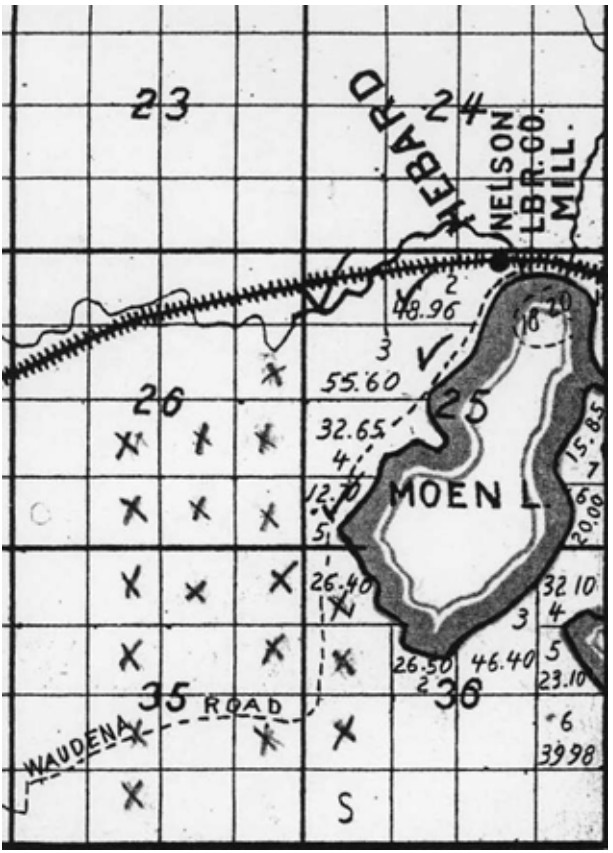
Moen Lake was named after John Moen, who came to the area in 1887 to build a sawmill for Jerome Nelson of Portage County. The company had purchased hundreds of acres surrounding the lake, specifically along the north shore. A side track was also built to connect with the Soo line which ran along the north end of the lake, as well as a boarding house. Eventually the area became known as Waudena. Business for the sawmill was good and a planing mill was added in 1894. The NelsonMoen Lumber and Boom Company ceased operations six years later.
As small sawmills closed, the lakes on which they sat transitioned from logging to residential areas to recreation. In the early 1900s, residential areas were created further from the city as better roads and transportation developed. In 1903, Charles Swails purchased the property once owned by Moen and Nelson – by this time, Waudena had been renamed Hebard – along with other land in the area, and built a farm. He continued to buy other pieces around Moen Lake, later dividing them into lots and re-selling them. In 1913, Hebard became Roosevelt, and Swails was the postmaster.
In the 1920s, a large interest in traveling brought more tourists to Oneida County, either by the ever evolving automobile or by train, and resorts and tourist camps began popping up around area lakes, and Moen Lake was no exception. Fred Risberg built a large pavilion on the west side of the lake in 1921 and provided a park for campers. Dances were held every summer at Moen’s Park. With the addition of several lodges and cabins, the business soon became Moen’s Lake Resort, now Pine Valley Lodge. On the north end of the lake, Charles Swails had also built a lodge and a few cottages, remaining in business into the 1930s. By 1926, Birchwood Lodge had been added to the Moen Lake area. Over the years, several other resorts and cottage rentals were built, many still in business. Generations of area residents made the trip to “Moon’s” Lake, as it was pronounced then, for summer parties.
But in the last decade, many of the resorts have disappeared. The lakes in the area seem to be making yet another transition – back to residential. Resorts are being sold and developed into residences, cottages are being torn down or made into larger homes. These changes have led to the creation of Lake Associations, whose memberships are concerned with zoning, water quality and wild life preservation, and making a future history on the lakes possible.
Special to the Daily News by Joy Vancos, 31 Jan 2009; additions 5 Feb 2009
The mill site on the north shore of Moen Lake also went through a few transitions. In 1889, when the area was known as Waudena, a post office was established. The name changed to Hebard in 1896. From 1913 to 1934, it was known as Roosevelt.